04/
Parkinson's Voice Screening — Refusing an Age-Confounded AUC
The strongest number this project produces is a cross-validated AUC of 0.912, and the analysis exists to explain why I will not claim it. The Parkinson's group averages 19 years older than the controls, and age alone separates the groups at AUC 0.864 — better than any voice-only model I trained. What survives the confound is a feature-selected, cross-validated AUC of 0.775 from acoustic features alone. Smaller number, defensible study.
Solo project — feature extraction, modeling, and writeup · Graduate coursework · IDS 506 Healthcare Information Management & Analytics, UIC MS MIS
81
Participants: 41 healthy controls, 40 with Parkinson's
165
Acoustic features per recording, three extraction pipelines
16
Models compared: 4 classifiers × 4 feature sets, 10-fold CV
0.912
Best CV AUC — refused as the headline: it is mostly age
10-fold CV AUC — the confound vs the voice signal
Voice-only CV AUC — feature selection vs the full set
01/
The finding
Sixteen models — four classifier families by four feature sets — trained to tell Parkinson's patients from healthy controls using sustained-vowel voice recordings. The best cross-validated AUC was 0.912, from XGBoost on every feature including demographics. The finding is that this number is not the result.
Exploratory analysis surfaced the problem before any model ran: the patient group averages 67 years old, the controls 48. Age alone — no audio at all — classifies at AUC 0.864, beating every voice-only model I trained. A model handed age, or anything correlated with it, gets to look brilliant by detecting birthdays.
The defensible result is voice-only: acoustic features filtered by univariate significance, cross-validated at AUC 0.775. The rest of the analysis is what it takes to trust even that smaller number — calibration, threshold behavior, and the limits an 81-sample study has to state.
02/
Context
Parkinson's changes the voice early — vocal-fold instability, breathiness, reduced loudness control — often before motor symptoms are obvious. That makes a short vowel recording a candidate for cheap, non-invasive screening, and it is why voice models keep appearing in the Parkinson's literature.
This was a case assignment for IDS 506, Healthcare Information Management & Analytics. I framed it as a clinical study rather than a leaderboard: the deliverable was a screening claim I could defend, with its confounds and calibration on the table and the methods grounded in eight peer-reviewed sources — not a single high number.
03/
The data
81 participants — 41 healthy controls, 40 with Parkinson's — each recorded a sustained /a/ vowel as a mono WAV at 8 kHz: telephone-quality audio with a 4 kHz ceiling on everything spectral. Sex is balanced across the groups. Age, as it turned out, is not.
From each recording I extracted 165 acoustic features in three pipelines: 17 phonation features via Parselmouth, a Praat wrapper — jitter, shimmer, harmonics-to-noise ratio, pitch and intensity statistics, formants F1–F4, duration, voiced fraction; 80 precalculated spectral coefficients that shipped with the dataset — LPC, LAR, cepstral, and MFCC means and variances; and 68 librosa features — 13 MFCCs and their deltas, spectral centroid, rolloff, bandwidth, per-band contrast, and zero-crossing rate.
An 80/20 stratified split — 64 training samples, 17 test, fixed seed — was held constant for every model. The audio and source spreadsheet are excluded from the public repository under course data-sharing restrictions; the notebook and its committed outputs are the public record.
04/
The confound
The group comparison ran before any classifier did. Controls average 47.7 ± 14.3 years; patients 67.0 ± 9.0 — a 19-year gap at p < 0.0001. Sex passes its chi-squared test. And a "classifier" that consists of the age column and nothing else scores AUC 0.864.
That one number reframes the project. Many acoustic features drift with normal aging — jitter rises, pitch range narrows, formant structure shifts — so a model trained on this cohort can achieve most of its separation without learning anything about Parkinson's. When the all-features-plus-demographics XGBoost reached 0.912 cross-validated, age sat at the top of its feature importances. The notebook says it plainly: models that include demographics are measuring the study design, not the disease. The honest comparison is voice-only.
05/
Sixteen models, and the curse of dimensionality
The grid was four classifiers — logistic regression, random forest, RBF-kernel SVM, XGBoost — by four incremental feature sets: 17 speech features, 97 adding the baseline spectral block, 165 adding the librosa block, 167 adding demographics. Hyperparameters stayed at established defaults, deliberately: with 64 training samples and up to 165 features, nested tuning is as likely to overfit the validation metric as to improve the model.
The fixed 17-sample test split turned out to be nearly useless on its own — one flipped prediction moves accuracy by six points — so every claim rests on 10-fold stratified cross-validation instead. CV delivered the classic small-sample verdict: adding features hurt. The 17 speech features alone cross-validated at 0.767; all 165 voice features managed 0.714.
Filtering recovered the signal. Univariate Mann-Whitney tests found 57 of the 165 features discriminating at p < 0.05; keeping the 85 that pass a liberal p < 0.20 screen raised the best voice-only CV AUC to 0.775. The selected features are almost all variance measures, elevated in Parkinson's — frame-to-frame instability, not average voice quality, is where the signal lives, consistent with the motor-control character of the disease.
06/
Reading it like a clinical study
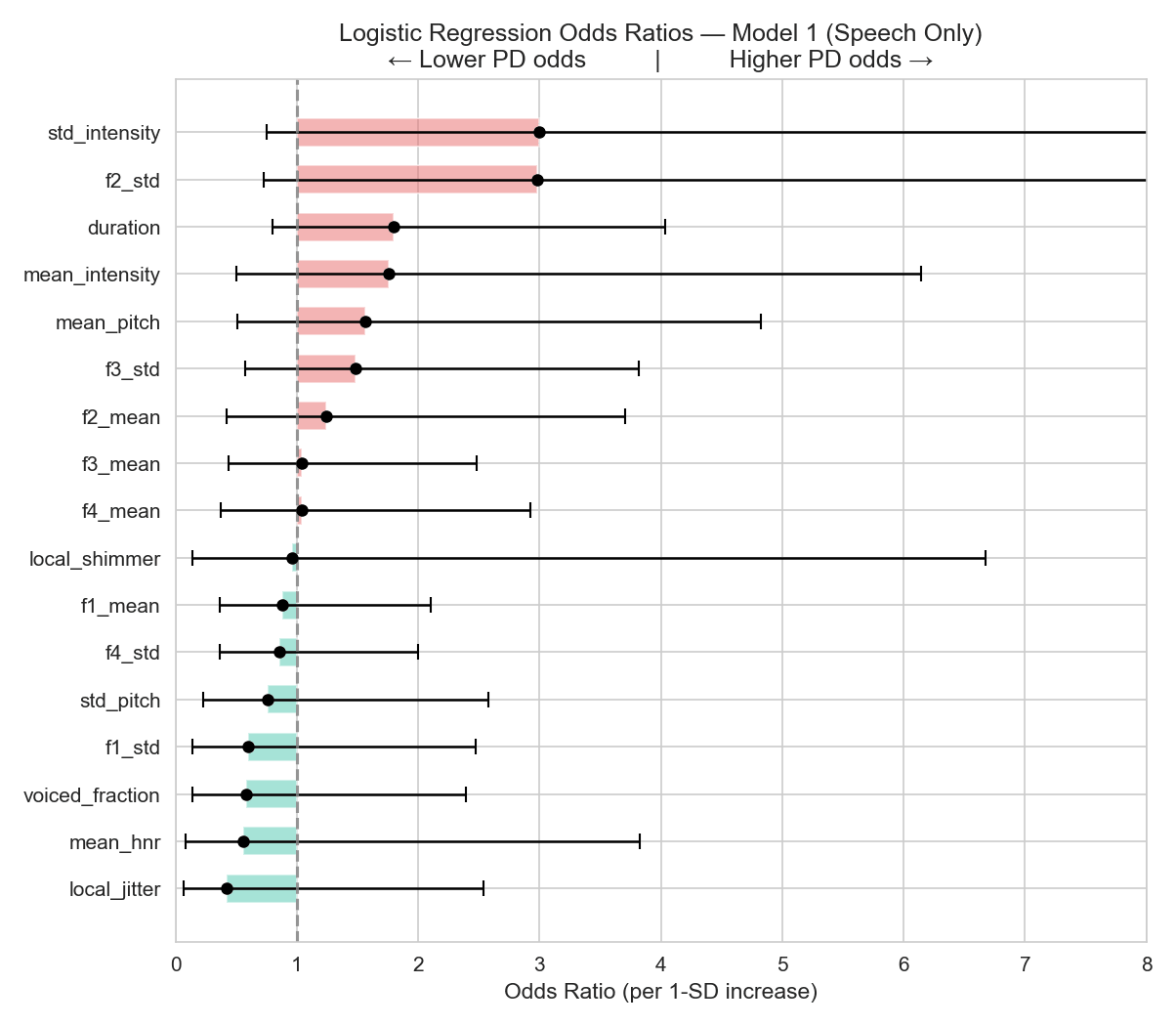
A screening claim needs more than a ranking metric, so the logistic regression got the clinical treatment. Odds ratios per standard deviation, with 95% confidence intervals: the largest effects are intensity variability and second-formant variability, each roughly tripling the odds — and every single interval crosses 1.0. At 81 samples, no individual feature clears significance, and saying so plainly is what the forest plot below is for.
Calibration held up better. A Hosmer-Lemeshow test on the predicted probabilities came back at p = 0.75 — the probabilities track observed rates, which matters when a probability is what triggers a referral. Threshold optimization became the cautionary tale instead: Youden's J, computed on the 17-sample test set, "optimized" to a 0.97 cutoff with 25% sensitivity — a degenerate operating point no screening tool would ship. At this scale the threshold has to come from clinical priorities — sensitivity first, because a false positive costs an exam while a false negative delays treatment — not from optimizing a curve.
07/
Limitations, and what I would do next
The limits are structural. Eighty-one samples caps statistical power — ten-fold cross-validation leaves about eight samples per held-out fold. The age gap cannot be convincingly adjusted away at this size; the clean fix is an age-matched cohort, not a covariate. Collapsing each recording to means and variances discards the temporal structure — pitch drift, tremor oscillation, voice breaks — that clinicians actually listen for. And a single sustained vowel at telephone quality says nothing about connected speech.
Next, in order: an age-matched or age-stratified design, since nothing else rescues the confound; connected-speech tasks, where prosody and articulation carry signal a vowel cannot; sequence models over the raw feature trajectories instead of summary statistics; and external validation on a separate cohort before the word "screening" gets used without qualification.